

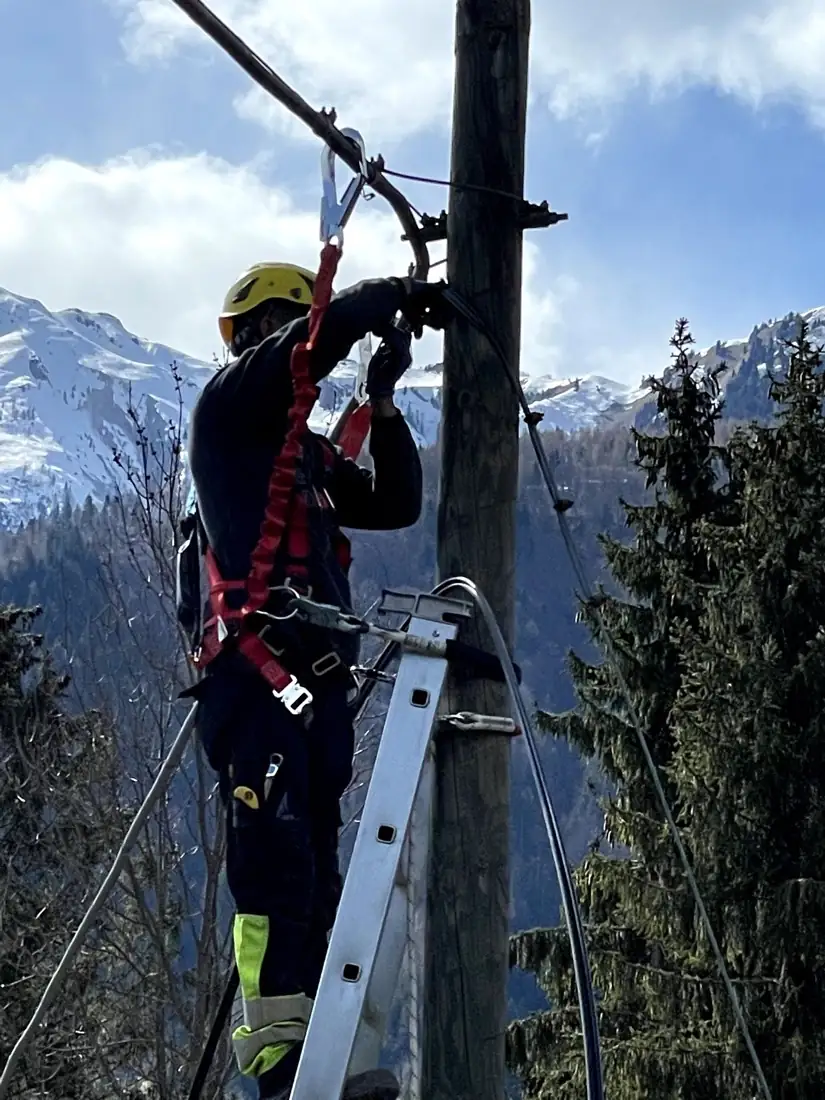
In our sector, serious accidents almost always have the same causes: a cable assumed to be dead, a badly footed ladder, an unshored trench wall. These situations are predictable, and for that very reason avoidable. Safety, for us, is not a bureaucratic formality: it is the reason people go home every evening.
Every job starts before we reach the site. We prepare the operational plan, identify the risks specific to that location (proximity to live lines, traffic, slope, buried services) and define the measures before anyone sets foot there. In the morning the crew spends a few minutes running through what will be done, who does what, and where the critical points are.
On electrical work we always follow the same sequence: isolate, verify the absence of voltage with an instrument, earth and short-circuit, then delimit the area. No step is skipped because "it will only take a second". For work at height we use harnesses, fall-arrest devices and verified anchor points, and on overhead lines we work in pairs, never alone.
In excavations the rule is just as firm: beyond a metre and a half of depth the wall is shored or battered, no exceptions. Most burials happen in trenches that the person working inside them considered shallow.
All of this requires constant training. Our staff is kept current on the mandatory courses (general and specific safety, first aid, fire prevention, work at height, and the qualifications for electrical work), and protective equipment is inspected and replaced when it needs to be, not when it expires on paper.
Finally, safety also concerns passers-by. Correct signage, stable barriers, protected pedestrian routes and night-time lighting are as much part of the job as laying a cable.
From the blog

Work with us: we're looking for new talent
We are looking for technical profiles to join our growing team.

How to choose the right partner for your networks
The criteria that make the difference when entrusting a public-utility work.

Innovation and quality in our works
How technology and method improve every job site.