

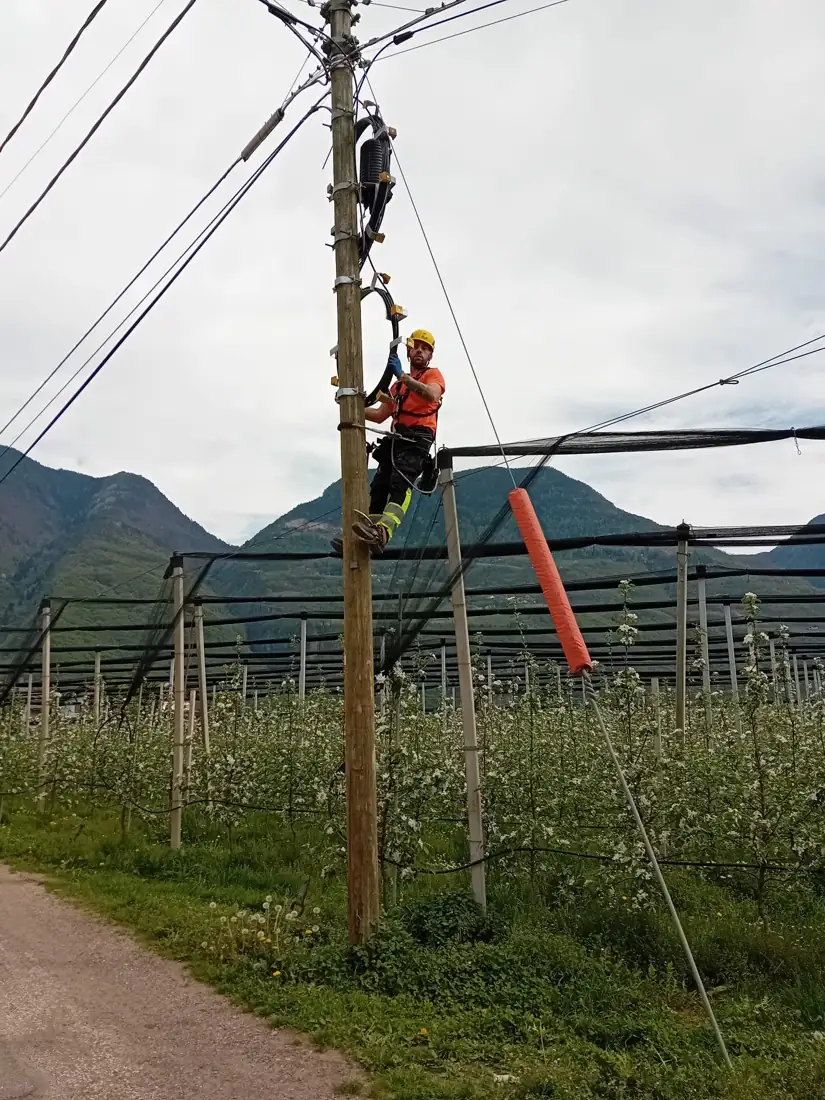
Working in South Tyrol means opening trenches in narrow valleys, crossing meadows, woods and orchards, and passing next to houses that people live in all year round. In a setting like this, environmental care is not a separate chapter of the project: it is how the site has to be organised from day one.
The choice of trenching technique is the decision that weighs most. Where possible we use micro-trenching and chain cutting, which reduce the width of the slot and therefore the volume of material moved and asphalt to be replaced. Where the route meets mature trees or significant root systems, we consider directional drilling, which allows us to pass underneath without touching the surface.
Reinstatement is the other half of the job. Excavated material is sorted and, when its characteristics allow, reused on site instead of being sent to landfill and replaced with new aggregate. On farmland and meadows we replace the fertile layer last, in the correct order, so that the sward closes over in the following season.
On public lighting the positive impact is more immediate. Replacing obsolete luminaires with LED units cuts consumption sharply, and choosing correct optics and warm colour temperatures limits light spill upwards and towards homes. Less energy used and less light pollution are the same intervention, not two conflicting goals.
Finally there are the daily practices, less visible but no less important: correct handling of site waste and spoil, machinery maintenance to contain fuel use and emissions, dust suppression, and respecting working hours in inhabited areas. These are small things that, added up across dozens of sites a year, make a real difference.
From the blog

Work with us: we're looking for new talent
We are looking for technical profiles to join our growing team.

How to choose the right partner for your networks
The criteria that make the difference when entrusting a public-utility work.

Innovation and quality in our works
How technology and method improve every job site.