

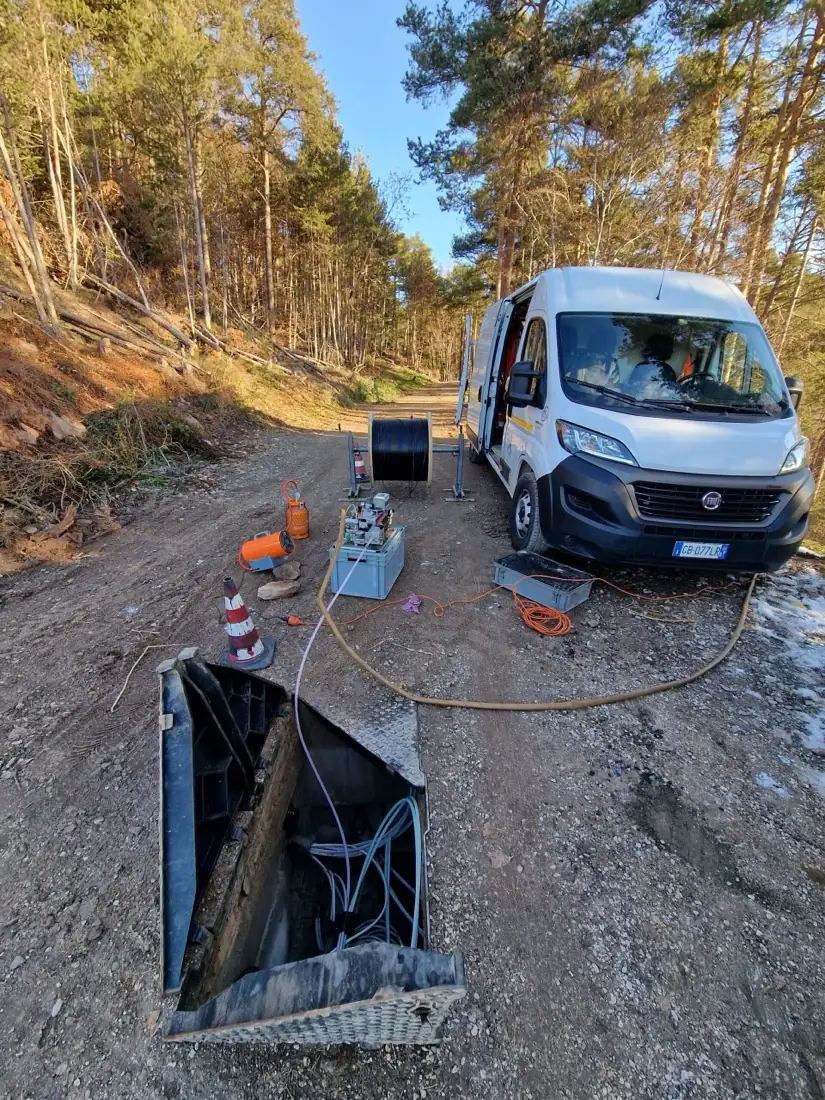
FTTH stands for Fibre To The Home: optical fibre all the way into the property. It describes a network in which the fibre cable physically reaches inside the home or office, with no final copper section. That is the substantial difference from the mixed solutions that were sold generically as "fibre" for years.
In FTTC networks, for example, the fibre stops at the street cabinet and the final stretch to the apartment remains twisted-pair copper. That stretch, which can be several hundred metres, determines the real speed: the longer it is, the more the signal degrades. With FTTH that bottleneck simply does not exist, and the speed measured in the home is very close to the contracted one.
The practical advantages are not only about download. Fibre offers low and stable latency, which matters for video calls and remote work, and much higher upload bandwidth, which counts when sending large files or using cloud services. It is also immune to electromagnetic interference and holds its performance regardless of the distance from the exchange, within very generous limits.
In construction terms, an FTTH network consists of a backbone connecting the exchange to the served areas, a capillary distribution network with chambers and optical cabinets, and the drop section that enters the building and reaches the user's socket. At DPM Perkola we build all three parts, including the splices and the OTDR acceptance measurements.
For a property owner the good news is that the infrastructure is passive and has a very long service life: once correctly installed, the same fibre supports future speed increases simply by changing the equipment at each end. It is an investment you make once.
From the blog

Work with us: we're looking for new talent
We are looking for technical profiles to join our growing team.
How to choose the right partner for your networks
The criteria that make the difference when entrusting a public-utility work.
Innovation and quality in our works
How technology and method improve every job site.