

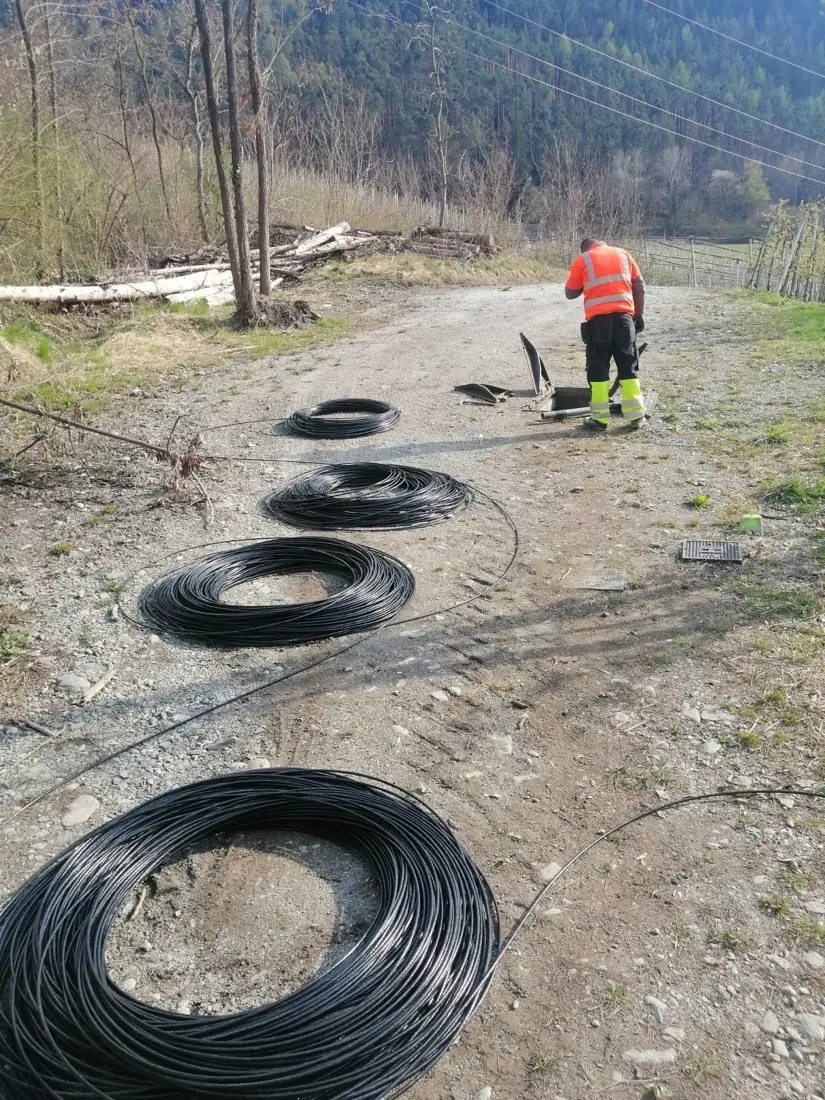
Bringing optical fibre into a dense urban area is mainly an organisational problem. Bringing it to a farmstead halfway up a slope, to a mountain hamlet or along a side valley is a technical, economic and logistical problem all at once. And yet that is exactly where connectivity changes people's lives the most.
The difficulties are concrete. Distances between buildings are long, so the cost per connected user rises quickly. The ground is sloping, often rocky, and the working window is limited by the season: above a certain altitude the period suitable for excavation shrinks to a few months. Add to this the landscape protection constraints and the need to cross private property, woodland and farmland.
The solutions come from choosing the right technique section by section. Where an overhead power line exists, it can make sense to install the fibre aerially on the same supports, drastically reducing excavation and cost. Where ducts or existing infrastructure are available, reusing them is the better option. Where digging is unavoidable, micro-trenching along the existing road is almost always preferable to a new route across open ground.
Mountain logistics then demand particular attention: manageable drum sizes, vehicles suited to narrow and steep roads, and the ability to work self-sufficiently far from the depot. We have learned that a day lost because a component was left down in the valley is worth double in these conditions.
The result, though, repays the effort. A connected hamlet means someone can work remotely without moving away, a guest farm can manage its bookings online, a small craft business can stay where it was founded. For a region like South Tyrol, where keeping outlying areas populated is a serious issue, the network is social infrastructure before it is technological.
From the blog
Work with us: we're looking for new talent
We are looking for technical profiles to join our growing team.
How to choose the right partner for your networks
The criteria that make the difference when entrusting a public-utility work.
Innovation and quality in our works
How technology and method improve every job site.